Modeling a Circular Economy in the European Flooring Sector with Stella Architect®
 Guy Verrue
Europe manufactures three billion square kilometers of flooring every year. That’s enough carpeting, laminates, tiling, and other materials to cover the entire European Union several times over with plenty left for other markets. It’s also enough to impose high environmental costs given energy-intensive production methods, raw material extraction, the use of chemicals, and factory emissions.
The environmental impact of flooring manufacturing is a concern of the European Union and members of the European Floor Covering Association (EuFCA). “EuFCA is an association of associations,” says Guy Verrue, Director General. “Members represent flooring manufacturers, technology/research institutes, and trade associations. Officially operational since 2009, the organization addresses the common interests of our members and the industry regulations and standards for social, environmental, economic, ethical, technical, and other perspectives.”
Key to reducing environmental impacts of manufacturing while delivering economic, social, and ethical benefits is the creation of a circular flooring economy – a sustainable cycle that minimizes waste by keeping materials in use as long as possible. Within that cycle, flooring products are manufactured, installed, uninstalled, and broken down into components that are used to make new products.
Creating a circular economy for flooring products across Europe is a huge challenge. There is little to no crossover in recycling and reuse with other industries. Practices in plastics, construction materials, textiles, or furniture don’t easily apply. Cultural differences cause consumer behaviors to vary from country to country. Flooring materials differ in recycling complexity and life span. For example, flooring made of composite materials can be hard to separate, and one type of laminate might last for years and another for decades.
EuFCA took a system dynamics approach to understanding the current European flooring economy and demonstrating how a circular economy that adheres to EU environmental standards and regulations can be built. A 16-member consortium secured a €7 million grant from the European Union to establish the Circular Sustainable Floor Covering (CISUFLO) project. “The project means to support new product development that utilizes used, recovered materials to drive the European flooring market towards a circular economy”, says Verrue.
With members experienced in system dynamics and system dynamics software, the CISUFLO team turned to Stella Architect to map, understand, and simulate improvements to the complex system.
CISUFLO Building Blocks
The CISUFLO model considers the European flooring market from the perspective of four stakeholder groups: floor covering manufacturers, material recycling companies, milling (cutting materials into smaller pieces) and sorting companies, and society (users of flooring products and those who experience its environmental impacts). “It is universal and expandable across flooring materials and country markets,” says Verrue. “The structure is based on Environmental Product Declarations (EDP), [including] verified reporting of a product’s life-cycle environmental impact from raw materials to disposal, set by International Organization Standards (ISO).”
Seven basic virgin and recycled raw materials and their costs, in Euros, are tracked through manufacturing, transportation and distribution, reclamation and recycling, milling and sorting, and back to manufacturing. The supply of materials available over time is an important consideration. “We talked to a company that wanted to use recycled bicycle tire tubes to create new products, but they realized solid tires that didn’t require tubes were going into production. There might not be a supply of used tire tubes in the future,” says Verrue.
Besides raw materials, key system inputs include:
- Transportation of materials between points in the manufacturing, recycling, milling and sorting, and warehousing processes
- Quantities of manufactured and assembled products
- Quantities of floor covering in use, in need of repair/refurbishment, and in need of replacement
- Quantities of deconstructed/demolished material and transportation to recycling operation or disposal
- Manufacturing, transportation, recycling, milling and sorting capacity
- Costs for each phase of the process
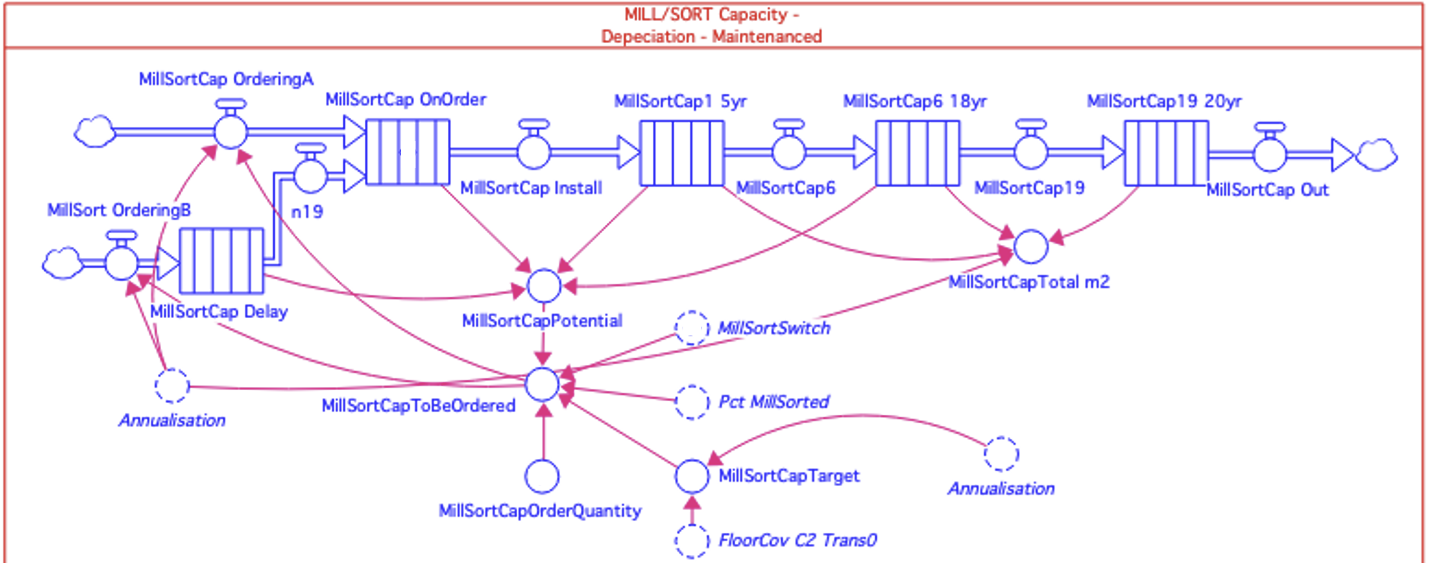 Mill/Sort capacity management
The model’s complexity comes from the many variables included in each area. For example, transportation methods and costs vary across materials, modes of transportation, and countries.
The model was built through an iterative process in which team members would consider drafts, make corrections and improvements, and add information. To test the model, the team asked EuFCA members for quantity and cost figures that described each factor. “They threw out numbers,” said Verrue. “When they saw them used in simulations they said, ‘Oh, we need to get you better numbers!’”
Circular Economy Feedback Loops
The CISUFLO model includes four main feedback loops that determine:
- The level of demand for each product
- The level of manufacturing investment needed to meet demand
- The level of recycling investment needed to meet demand
- The level of milling and sorting needed to meet demand
The model includes delays that allow recycling operations to reach capacity, meet demand, and adapt to any announced government regulations and requirements. It also accommodates advances in recycling technology.
“It’s easy for stakeholders who have no system dynamics or Stella Architect experience to interact with the model,” says Verrue. “Rather than getting into the model itself, they use sliders and dials to see how their current operations change when variables are adjusted. For example, they can see how costs change when government recycling targets or demand for particular products change.”
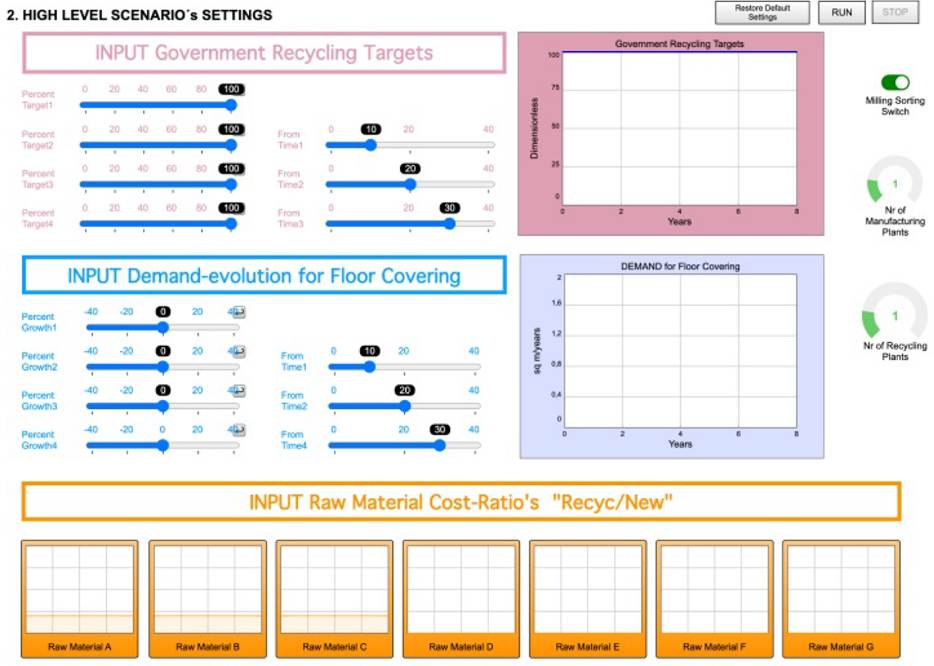 Model simulations run with default or user-adjusted settings
Stella Architect also made model building easier for the CISUFLO team. “CISUFLO is very complex with many variables and Stella Architect’s ability to automatically check and resolve conflicts between them was very helpful,” says Verrue. “The module videos were also appreciated. They gave us good ideas for improved model cosmetics and kept us from reading through the user’s manual.”
Use of the model in the future
“I’m using the model now, and manufacturers are looking at it and planning to use it to understand their systems and assist their EDP reporting,” says Verrue. “The model is also available to EuFCA members and, as the EU increases pressure to reduce environmental impacts, there will be more demand for the model. New EU standards are being set for 2031, so manufacturers will need to be sure their processes are solid to avoid legal action.”
As important as ensuring adherence to EU mandates, manufacturers must sustain the health of their business. “Using the CISUFLO model, manufacturers can identify high- and under-performing products and materials to maximize profits.”
Verrue points out that the model is useful to young entrepreneurs who are investigating new products and recycling processes. “EuFCA and CISUFLO will support all players in the circular flooring economy into the future.”